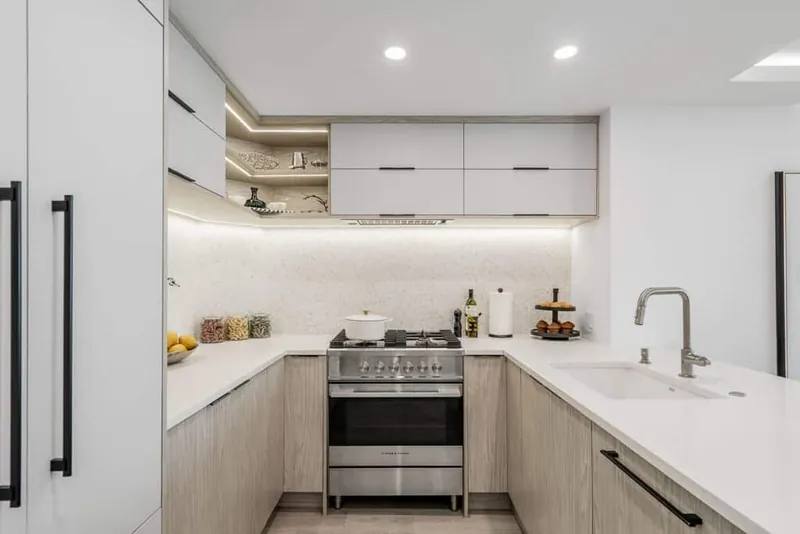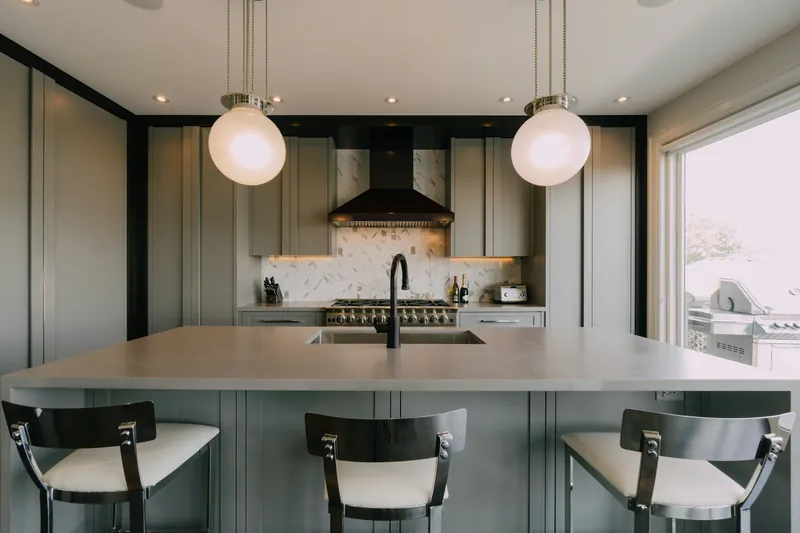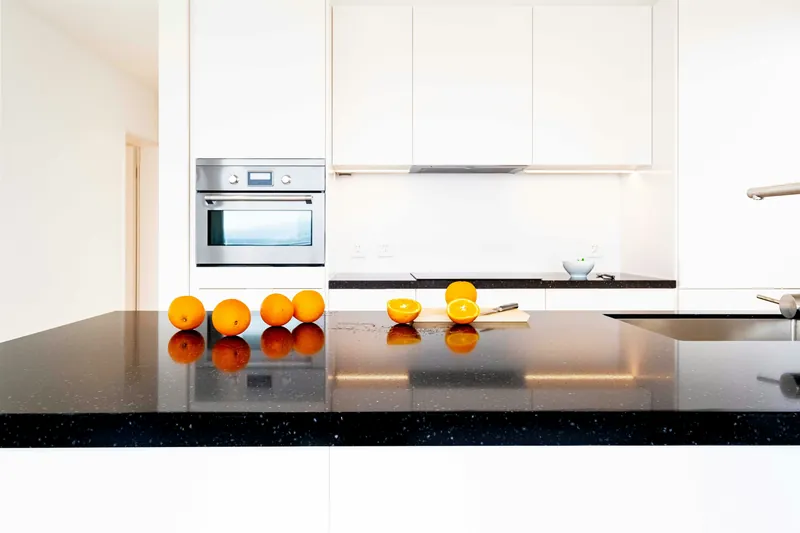
Engineered quartz is roughly 90 to 93% ground natural quartz bound with polymer resin and pigment. That composition is why it behaves the way it does: the quartz gives it hardness, and the resin fills every pore so there is nothing for liquid to soak into.
In a working family kitchen that combination is hard to beat. Red wine, lemon juice, turmeric and olive oil all wipe off a quartz counter and none of them leave anything behind, which is not true of any natural stone.
Is quartz better than granite for a kitchen?
For most kitchens, yes. Quartz is non-porous so it never needs sealing and cannot stain; granite is porous and needs resealing every one to three years. Quartz is also consistent slab to slab. Granite wins on one point only: heat resistance.
| Quartz | Granite | Marble | |
|---|---|---|---|
| Installed cost/sq ft | $80 – $150 | $85 – $160 | $140 – $300+ |
| Sealing | Never | Every 1 – 3 years | Yearly or more |
| Stains? | No | If unsealed | Yes |
| Etches from acid? | No | Rarely | Yes, permanently |
| Heat tolerance | To ~150°C — use a trivet | Excellent | Excellent |
| Consistency | Predictable, matches the sample | Every slab differs | Every slab differs |
| Repairable | Chips can be filled | Chips can be filled | Can be re-honed |
| Warranty | 10 – 25 years typical | None from the stone | None from the stone |
The short version: quartz unless you set hot pans down directly, in which case granite.
How much does quartz cost installed?
Quartz countertops cost $80 to $150 per square foot installed in Vancouver. A typical kitchen of 40 to 55 square feet including an island comes to $3,800 to $9,500. Entry-tier colours sit near $80; premium marble-look patterns with heavy veining sit at the top.
The extras that move the number: a mitred edge at 60 or 80 mm adds $60 to $120 per linear foot, a waterfall island end $900 to $2,400 per end, and each cutout beyond the sink and cooktop $150 to $400.
Where not to spend: the visual difference between a $95 and a $150 quartz is usually pattern complexity, not quality, and the durability is identical.
Choosing a quartz that will not date
Quartz patterns follow fashion more visibly than natural stone does, because the pattern is designed rather than geological. The heavy grey-veined marble-look that dominated 2018 to 2022 is already reading as of its moment.
What ages well: soft, low-contrast patterns and near-solid colours in warm whites, greiges and blacks. What dates fastest: high-contrast dramatic veining, and the speckled granite-imitation patterns of the 2000s.
A practical note for Vancouver kitchens specifically — a very dark, high-gloss quartz shows dust, crumbs and water spots badly in a room that gets low grey light for months. A honed or textured finish in the same colour solves it.
Living with quartz
- Clean with soap and water or a pH-neutral cleaner. Nothing else is needed, ever.
- Use a trivet. Resin binder can scorch above roughly 150°C and the damage is permanent.
- Avoid bleach, oven cleaner and any strongly alkaline product — they can dull the surface over time.
- Cut on a board. Quartz will blunt your knives long before your knives mark it.
- Wipe spills of anything strongly coloured within a day — quartz does not stain, but dried-on turmeric still needs scrubbing.
- Direct prolonged sunlight can fade some pigments; relevant on a south-facing peninsula, not on an interior run.
Brands and what actually differs between them
Caesarstone, Silestone, Cambria, Hanstone, Vicostone and Corian Quartz are the names we install most in this market. Technically the material is very similar across all of them; what differs is pattern range, slab size, warranty terms and price.
Slab size matters more than people expect. A jumbo slab at roughly 3,200 × 1,600 mm can produce a seamless island where a standard slab cannot, so on a large island the available slab size may decide the brand.
Warranties run 10 to 25 years and almost all are limited to manufacturing defects — not to heat damage, chipping or anything caused in use. Read what is actually covered before treating a long warranty as a differentiator.