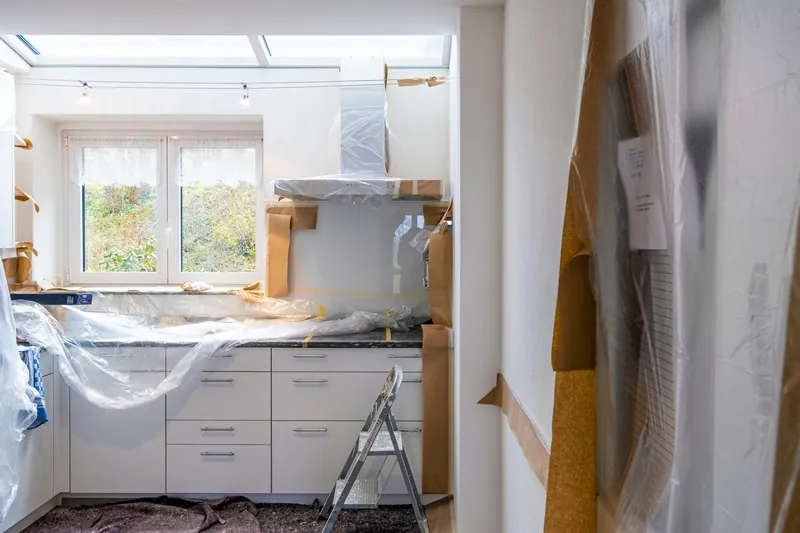
Demolition is two to four days of a kitchen renovation and determines a surprising amount of what follows. Ripping cabinets off a wall takes the drywall face with them; levering up tile without care cracks the subfloor; and nobody notices any of it until the new work will not sit flat.
We also do demolition as a standalone service, for owner-builders and for people doing the rest themselves.
What does kitchen demolition cost?
Kitchen demolition and disposal costs $1,500 to $4,000 in Vancouver for a typical kitchen, including dust containment, strip-out, hauling and disposal fees. A hazardous materials survey on a pre-1990 home adds about $400, and abatement, if needed, $2,000 to $12,000.
| Item | Cost (CAD) | Notes |
|---|---|---|
| Full kitchen strip-out and disposal | $1,500 – $4,000 | Cabinets, counters, tile, flooring, appliances |
| Dust containment and air scrubber | Included | Zip-wall barrier, floor protection, HEPA filtration |
| Hazardous materials survey (pre-1990) | $350 – $550 | Required before demolition; a few days for results |
| Asbestos abatement if found | $2,000 – $12,000 | Licensed abatement contractor; not optional |
| Removing a non-structural wall | $800 – $2,500 | Includes making good |
| Floor tile and thinset removal | $700 – $2,200 | Labour-intensive; the item most often underquoted |
| Condo disposal surcharge | $300 – $900 | Elevator bookings, corridor protection, no skip on site |
Asbestos: why every pre-1990 kitchen gets tested
Homes built before 1990 in British Columbia may contain asbestos in vinyl floor tile, sheet flooring backing, drywall joint compound and textured finishes. WorkSafeBC requires a hazardous materials survey before demolition. It costs $350 to $550 and takes a few days.
This is not a precaution we choose to take. It is a legal requirement, and WorkSafeBC enforces it. A contractor who offers to skip it is telling you something important about how they work generally.
Most surveys come back clear or find asbestos only in materials that are not being disturbed. Where abatement is needed it goes to a licensed abatement contractor, costs $2,000 to $12,000 depending on scope, and adds three to seven days.
The material most often positive in Vancouver kitchens is 9-inch vinyl floor tile and its black mastic, and the sheet flooring installed over it in the 1970s.
Containing dust in an occupied home
Sealing the HVAC returns is the step most often skipped and the one that causes the most complaints. Construction dust drawn into a forced-air system gets redistributed through the whole house and keeps arriving for weeks after the work finishes.
- Zip-wall barrier with a zippered door across every opening into the kitchen
- HEPA air scrubber running inside the barrier at negative pressure, so air moves in rather than out
- Floor protection along the entire route from the kitchen to the exit
- Forced-air vents in the work area sealed so dust does not enter the duct system and get distributed to the whole house
- Doors and stair balustrades protected on the removal route
- Daily clean-down rather than a single clean at the end
What we protect and what we save
Careful demolition means cutting cabinets away from the wall rather than levering them, which leaves the drywall face intact and avoids a day of patching. It means checking behind a wall before opening it, in case a supply or a circuit runs where nobody expects. And it means finding out what is under the floor before committing to lifting it.
Cabinetry in usable condition is worth offering to a reuse organisation rather than sending to landfill — Habitat for Humanity ReStore and similar outlets in Metro Vancouver accept kitchens. Appliances in working order too. It costs a little coordination and keeps a substantial volume out of the waste stream.
Where a client wants to keep something — a butcher block section, a heritage door, an original farmhouse sink — tell us before we start rather than after.
Demolition in a condo
There is no skip outside a downtown tower. Everything leaves through the service elevator in a booked window, along protected corridors, in bags and bins that fit the lift. That is why condo demolition carries a surcharge and takes longer than the same kitchen in a house.
Waste also cannot be staged in a corridor or in the parkade overnight in most buildings, so demolition volume has to be matched to the disposal runs available that day. See condo kitchen renovations.