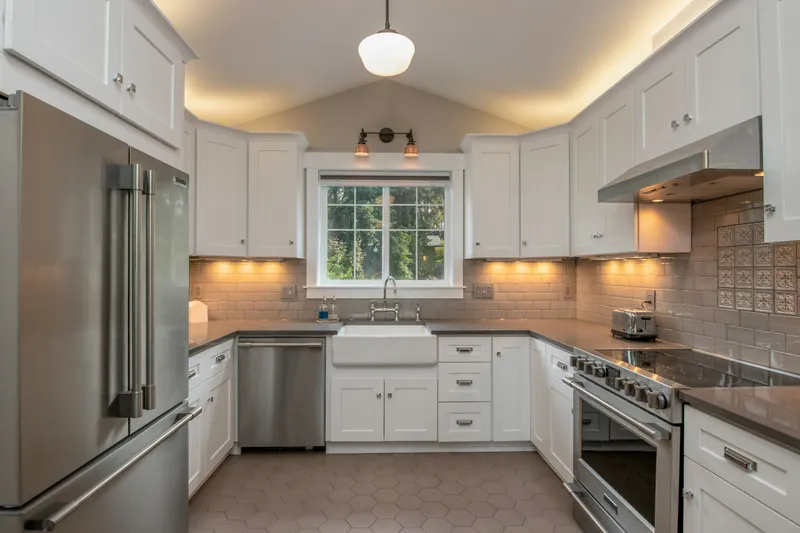
Replacing a sink and tap is the smallest job we do and the one that most often gets people into the house for the first time. It is also the one where the details behind the cabinet door matter more than anything visible.
The critical sequencing point: if you are replacing countertops, the sink has to be chosen before templating. The cutout is fabricated to your specific sink model, and changing your mind afterwards means a new slab.
Which kitchen sink should I choose?
A single-bowl undermount stainless sink of at least 750 mm suits most kitchens: the biggest usable bowl for the cabinet, easy to wipe into, and the cheapest to replace. Choose an apron-front for looks and reach, or a workstation sink if counter space is genuinely short.
| Sink type | Cost supplied (CAD) | Pros | Watch out for |
|---|---|---|---|
| Undermount stainless, single bowl | $300 – $900 | Wipe straight in; maximum bowl; cheap to replace | Shows water spots on a mirror finish |
| Undermount, double bowl | $400 – $1,100 | Separate wash and rinse | Neither bowl fits a baking sheet |
| Apron front / farmhouse | $700 – $2,600 | Reach without leaning; a focal point | Needs a purpose-built base cabinet |
| Workstation with accessories | $600 – $2,200 | Boards and racks over the bowl | Accessories are brand-specific and get lost |
| Composite granite | $450 – $1,300 | Quiet, warm, hides marks | Can stain in lighter colours |
| Fireclay | $800 – $2,400 | Traditional look, very hard | Heavy; can chip on impact |
| Integrated (solid surface) | Part of the counter | Seamless, no rim at all | Replaced only with the counter |
Our default recommendation: a single bowl at least 750 mm wide, in 16-gauge stainless with sound-deadening pads, undermounted. It fits a full baking sheet, which no double bowl does.
Choosing a tap that lasts
Two things predict how long a kitchen tap lasts: whether the body is solid brass rather than zinc alloy, and whether the cartridge is a serviceable ceramic disc unit you can buy a replacement for in ten years.
A pull-down spray is more useful than a pull-out in a deep single bowl, and a high arc matters if you fill stockpots. Touchless taps are genuinely convenient with raw chicken on your hands and add a battery or transformer that will eventually need replacing.
Finish note for this region: unlacquered brass will patina, which is intentional and looks superb in a character kitchen. Matte black shows hard-water spotting more than any other finish, which matters less in Vancouver’s soft water than in most Canadian cities.
What is actually under the sink
The supply lines are the item worth being firm about. A failed braided line is among the most common causes of the kitchen floods we attend — see water damage restoration. They cost under $40 and get replaced every time we change a tap.
- P-trap correctly configured — no flexible accordion pipe, which traps debris and is not code-compliant
- Dishwasher drain hose high-looped or connected to an air gap to prevent backflow
- Isolation stop valves on both supplies so the tap can be changed without shutting the house down
- Braided stainless supply lines, replaced whenever a tap is changed — the old rubber ones are what burst
- Undermount sink supported by clips and a rail, not silicone alone; the weight of a full sink is significant
- Sealed or lined cabinet floor beneath, because this is where every leak in a kitchen shows up
Filtered water, instant hot and pot fillers
An under-sink filter with a dedicated tap costs $400 to $900 installed. An instant-hot dispenser is $600 to $1,400 and needs a dedicated circuit. A pot filler over the range is $700 to $1,800 and requires a water line run inside an exterior or interior wall.
Vancouver’s tap water comes from protected mountain reservoirs and is soft and clean, so filtration here is about taste and chlorine rather than hardness or contamination. A simple carbon filter does the job; reverse osmosis is rarely necessary in this city.
Pot fillers are the one to think hardest about. They look impressive and get used less than people expect, and a water line in a wall behind a range is a leak in a place you will not see it. If the range is on an exterior wall, the line also needs protecting from freezing.
Replacing a sink and tap on their own
A straight swap into an existing cutout takes two to four hours. Changing the sink size or type is different: the cutout in a stone counter can sometimes be enlarged in place with a diamond blade, but a smaller sink cannot fill a bigger hole and the counter has to be replaced.
Bring us the model number before ordering and we will tell you whether it fits your existing cutout. It is a five-minute check that has saved a lot of people the cost of a countertop.