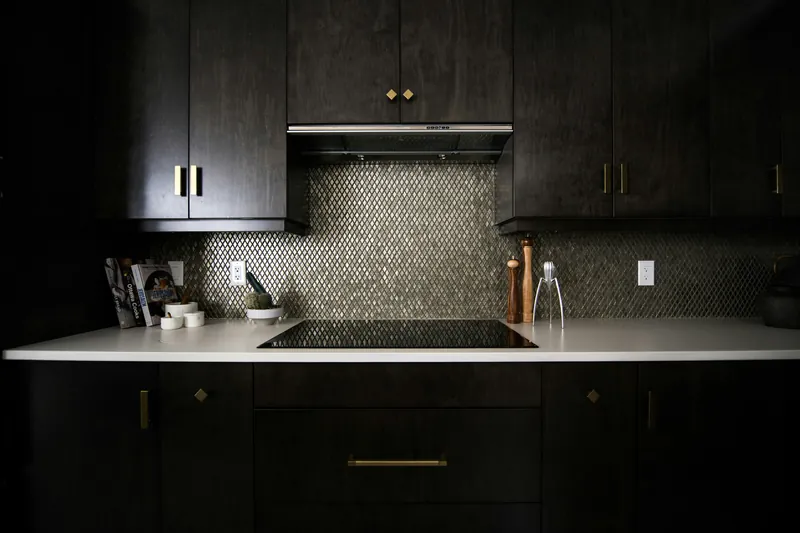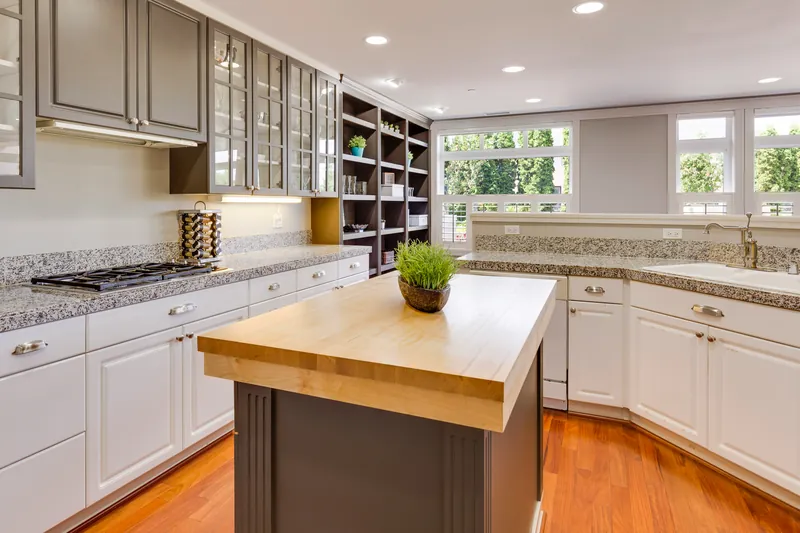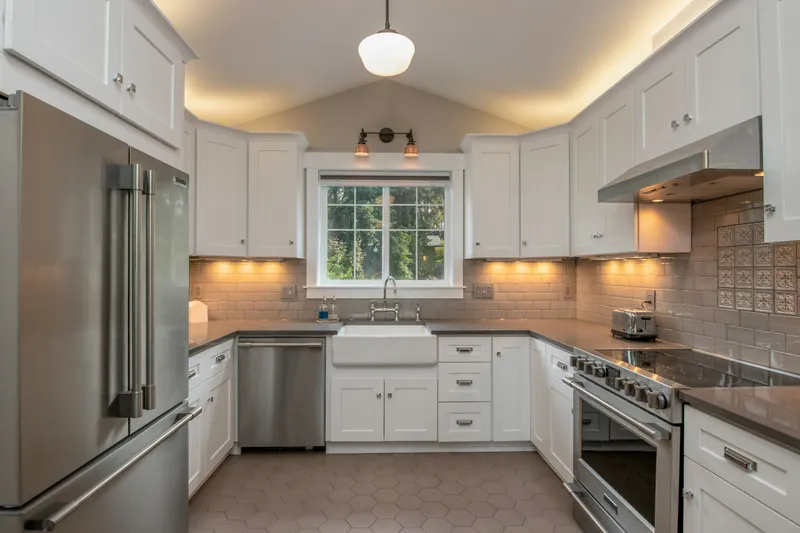
Refacing keeps the cabinet carcasses and replaces everything you see: doors, drawer fronts, hinges, handles, and a matching veneer or laminate applied to the exposed face frames and end panels.
Done properly it is indistinguishable from new cabinetry. Done badly — thin peel-and-stick film over a dirty frame — it looks exactly like what it is. The difference is almost entirely in the preparation and in whether the boxes deserved it in the first place. One reviewer put it plainly: "They refaced my cabinetry and it looked great!"
Should I reface or replace my kitchen cabinets?
Reface if the boxes are structurally sound, the layout works and you are happy with the drawer configuration. Replace if any box is swollen or sagging, if the layout needs to change, or if you want deep drawers where there are currently doors and shelves.
The test takes thirty seconds. Open the sink base and look at the bottom and the back panel. Push sideways on a cabinet and see whether it racks. Check whether any shelf is bowed. Any of those means refacing is money spent on top of a problem.
| Refacing | New cabinets | |
|---|---|---|
| Cost, typical kitchen | $7,000 – $16,000 | $15,000 – $65,000 |
| Time on site | 3 – 7 days | 3 – 6 days install, 4–10 weeks lead |
| Kitchen usable during work | Mostly — sink and counters stay | No |
| Can change the layout | No | Yes |
| Can add deep drawers | Limited — within existing openings | Yes |
| Interior of cabinets | Stays as it is | New |
| Waste to landfill | Minimal — boxes stay | Full kitchen |
| Realistic lifespan | 15 – 20 years | 20 – 30+ years |
Refacing typically costs 40–60% of replacement. Where it does not make sense, we say so at the measure rather than taking the easier sale.
What refacing includes
What refacing does not include is the inside of the cabinets, the layout, or the boxes themselves. Interiors can be relined with a matching laminate for an extra $600 to $1,500 across a kitchen, which is worth it if they are stained or dated.
- New doors and drawer fronts in your chosen style, colour and material
- Matching veneer or rigid laminate applied to face frames, end panels and any exposed carcass edge
- New concealed soft-close hinges throughout — the old ones are usually the reason doors sit unevenly
- New handles or knobs
- New drawer boxes where the existing ones are worn, with full-extension soft-close runners
- Adjustment of every door and drawer to a consistent reveal — the detail that decides whether it looks new
- Optional: new crown or light rail, open shelving, a new panelled end to an island
How long does refacing take?
Three to seven days on site for a typical kitchen, after a two to three week manufacturing lead for the doors. You keep the sink and the counters throughout, so the kitchen stays broadly usable — which is the practical reason many people choose refacing over replacement.
Measure and template
Every door and drawer measured, hinge positions recorded, frame faces surveyed for damage.
2 hoursManufacture
Doors, drawer fronts and matching veneer made to order.
2–3 weeksPreparation
Old doors and hardware removed, frames cleaned, degreased and sanded. This is the step that cheap refacing skips.
1 dayVeneer and install
Faces veneered, new doors hung, drawer fronts fitted, hardware installed.
2–4 daysAdjustment
Every door and drawer set to a consistent gap. Nothing is left ’close enough’.
half a dayRefacing in a condo
Refacing is often the ideal condo solution. It generates almost no debris, needs no plumbing or electrical work, takes days rather than weeks, and in many buildings it does not require a full strata alteration agreement — though you should always check, because some stratas require notification for any contractor work.
It also avoids the two hardest parts of condo renovation entirely: the service elevator booking for a full kitchen delivery, and the disposal of a whole kitchen through a shared corridor. See condo kitchen renovations.
What good refacing looks like up close
The face frame veneer should wrap the frame edge, not stop at it. The seam between veneer and the original frame should be invisible with a door open. Hinge cups should be freshly bored into the new doors rather than reusing worn positions. And every reveal — the gap between adjacent doors — should be the same within about a millimetre across the whole kitchen.
That last one is what separates refacing that reads as a new kitchen from refacing that reads as a repair. It is also the step most often rushed, because it takes half a day and nobody notices it being done.