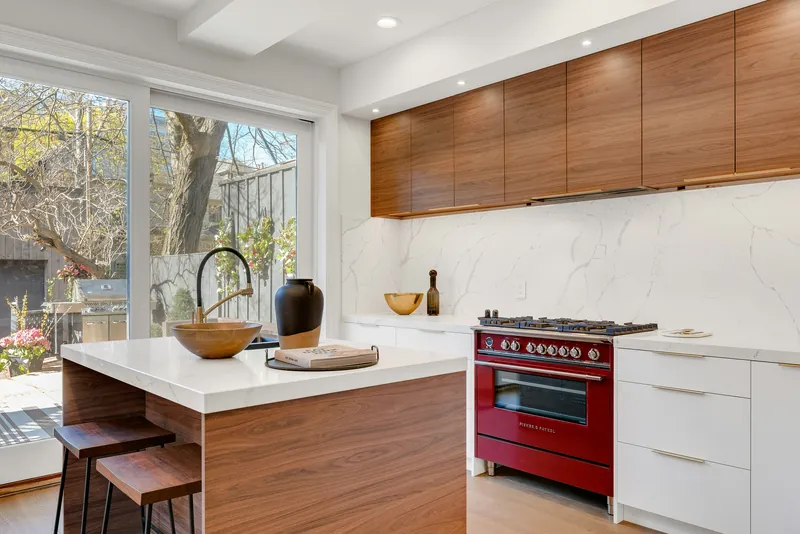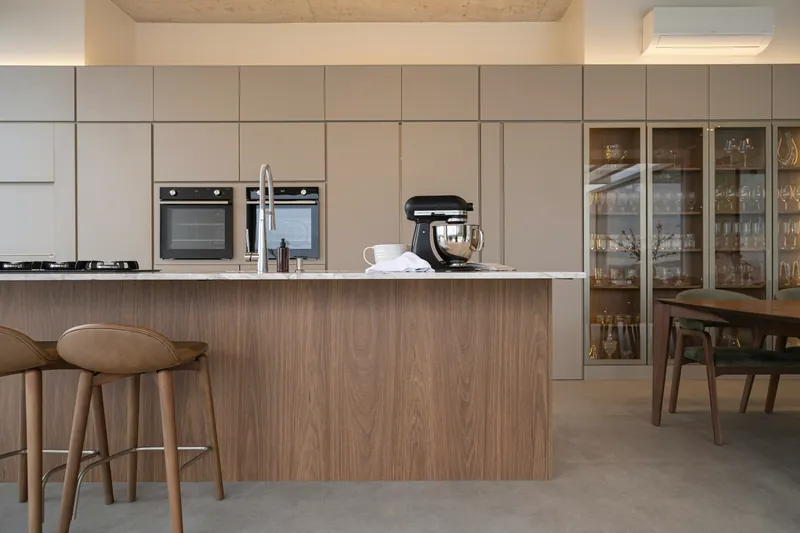
Custom cabinetry means the boxes are manufactured to the dimensions of your room rather than selected from a catalogue of fixed widths. In a new townhouse that is a nicety. In a 1920s house in Kitsilano or a Dunbar tudor it is the difference between a fitted kitchen and a row of boxes with packing strips between them.
It is also how you use the height. Vancouver’s older housing stock has 8 ft 4 in and 9 ft 2 in ceilings that stock cabinetry has no answer for, which is why so many kitchens here have a dust-collecting soffit instead of another 400 mm of storage.
What does custom cabinetry actually cost?
Fully custom kitchen cabinets in Vancouver cost $30,000 to $65,000 installed for a typical 12-cabinet kitchen. Semi-custom — some sizing flexibility on a standard catalogue — is $15,000 to $28,000. Stock boxes are $8,000 to $14,000.
The price difference is not decoration. It is carcass material, how the boxes are sized, hardware quality and how the finish is applied.
| Stock | Semi-custom | Fully custom | |
|---|---|---|---|
| Cost installed, 12 cabinets | $8,000 – $14,000 | $15,000 – $28,000 | $30,000 – $65,000 |
| Carcass | 16 mm melamine particleboard | 16–19 mm plywood or HDF | 19 mm plywood throughout |
| Sizing | Fixed widths, 150 mm steps | Fixed widths, some modification | Any dimension to the millimetre |
| Finish | Factory foil or laminate | Factory paint or laminate | Catalysed lacquer, sprayed and cured |
| Drawer runners | Soft-close, mid-range | Soft-close full-extension | Premium full-extension, weight-rated |
| Lead time | 1 – 2 weeks | 4 – 6 weeks | 6 – 10 weeks |
| Realistic lifespan | 10 – 15 years | 20 – 25 years | 30+ years |
Most of our clients land on semi-custom. Fully custom earns its price in older homes, awkward rooms and anywhere the ceiling is not 8 feet.
Why plywood carcasses matter in this climate
Plywood carcasses resist moisture far better than particleboard. In a Vancouver kitchen — high ambient humidity for eight months of the year, plus the sink base and dishwasher — a particleboard box that gets wet swells irreversibly, while plywood dries out and stays dimensionally stable.
The sink base is the specific point of failure. It is the cabinet that takes drips from a tap flange, condensation off a supply line, and the occasional real leak. It is also the one most often made from the cheapest material in the kitchen.
We build sink bases in plywood with a sealed or lined floor, regardless of what the rest of the kitchen is specified in. It costs very little and it is the cabinet most likely to be the reason a kitchen gets replaced early.
Drawers versus doors
Deep drawers hold roughly 40% more usable volume than a door and fixed shelf of the same width, and everything in them is reachable without kneeling. For base cabinets, drawers are the single upgrade clients notice most in daily use.
- Pot drawers in place of a door-and-shelf base: the most-mentioned upgrade after the work is done
- A 150 mm pull-out beside the range for oils and spices clears the counter permanently
- Corner solutions — magic corner or carousel — recover about 0.4 m³ of dead space
- Toe-kick drawers add 40 to 60 litres that most kitchens simply throw away
- Full-extension runners so the back of the drawer is actually usable
- Weight-rated runners on pot drawers: a drawer of cast iron is 40 kg and standard runners sag
How custom cabinetry gets made and installed
Site survey
Every wall measured at three heights, floors levelled, ceilings checked. The out-of-plumb is recorded, not ignored.
Day 0Shop drawings
Plans, elevations and a 3D rendering. You approve every cabinet dimension before anything is cut.
1–2 weeksManufacture
Carcasses cut and assembled, doors made, everything sprayed and cured in a booth.
6–10 weeksDelivery and dry fit
Boxes set in position, checked against the room before anything is fixed.
1 dayInstall and scribe
Boxes levelled and fixed, end panels scribed to the wall, doors hung and adjusted to a consistent gap.
3–6 daysFinishes, and how they behave over time
Sprayed catalysed lacquer is the standard for painted cabinetry. It cures hard, cleans easily and does not show brush texture. Painted MDF doors take it better than solid wood for a flat colour, because MDF has no grain to raise and no joints to move seasonally.
For a wood finish, veneered doors give a continuous grain across a run that solid timber cannot, and they do not move with humidity the way solid panels do. In a climate that swings from 40% to 80% relative humidity, that stability matters.
The finish to think twice about is high-gloss. It looks superb in a showroom and shows every fingerprint and micro-scratch under the low raking light of a Vancouver winter afternoon. Matte fingerprint-resistant laminates have largely replaced it for good reason.