Most kitchen lighting we replace has one layer: a row of downlights straight down the middle of the ceiling. That single decision puts every light source behind whoever is working, casting their own shadow onto every work surface.
Fixing it is neither expensive nor difficult, but it has to happen at rough-in. Once the drywall is closed and the cabinets are in, moving a circuit is a different job entirely.
How should a kitchen be lit?
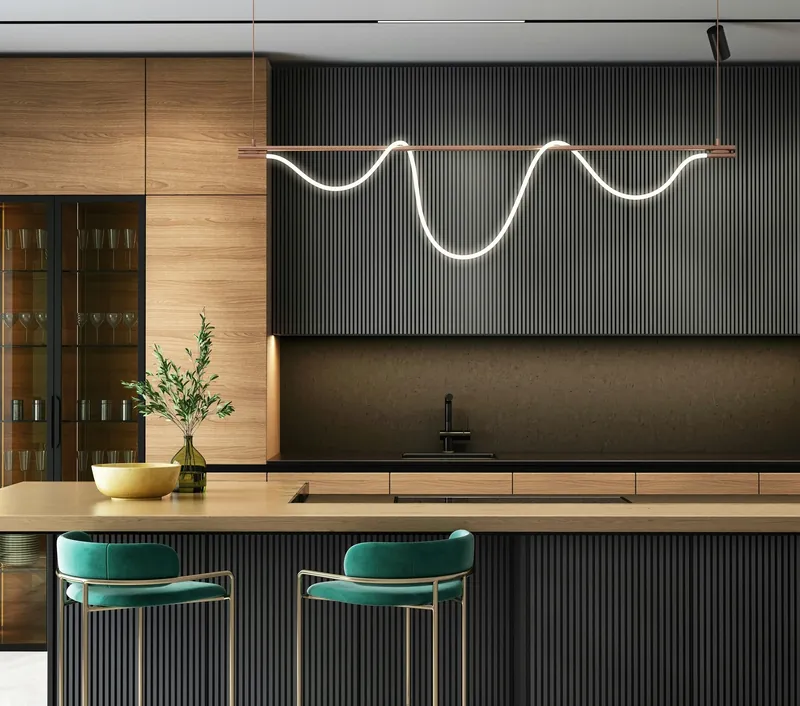
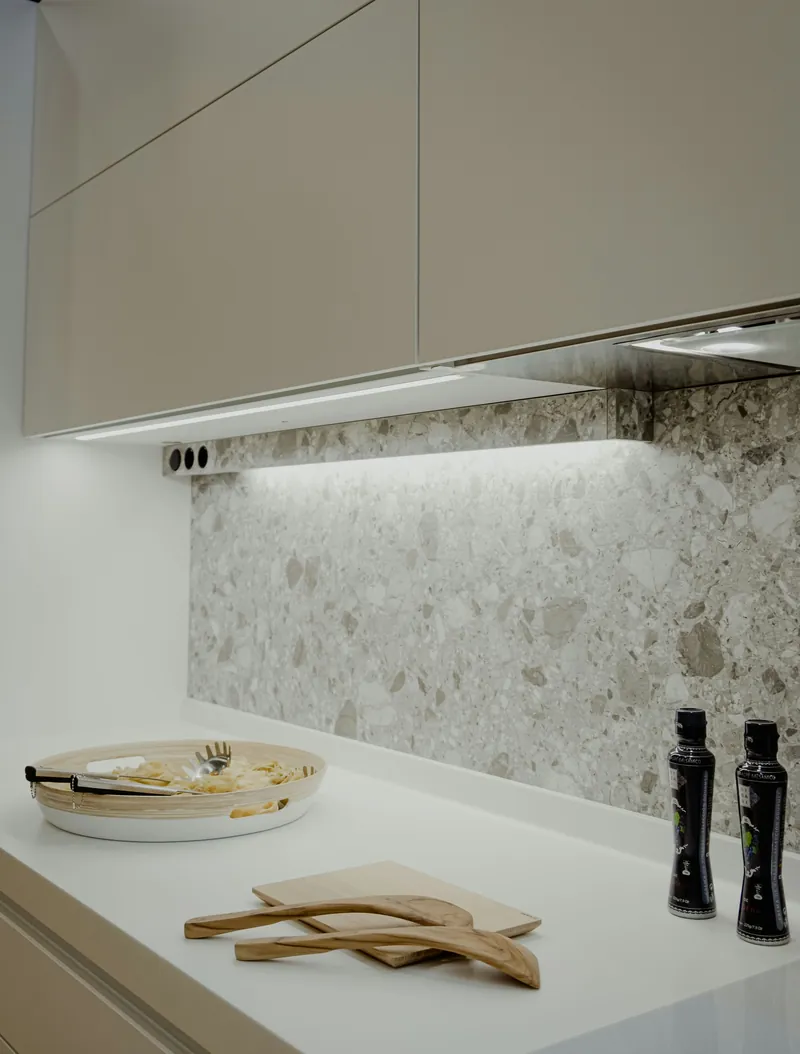
In three layers. Task lighting — a continuous LED strip under the wall cabinets — lights the counter without your body in the way. Ambient lighting — recessed downlights positioned over the front edge of the counter — lights the room. Feature lighting — pendants over an island — gives the room a focal point.
| Layer | What it does | Cost installed (CAD) | Specification |
|---|---|---|---|
| Under-cabinet task | Lights the work surface with no shadow | $600 – $1,800 | Continuous LED strip in an aluminium channel, dimmable |
| Recessed ambient | General light for the room | $150 – $280 per fitting | Positioned 600–750 mm from the wall, over the counter edge |
| Island pendants | Focal point and light on the island | $400 – $2,500 total | Bottom of shade 750–900 mm above the counter |
| In-cabinet / glass front | Display lighting | $250 – $900 | Warm, low output, on its own switch |
| Toe-kick / plinth | Night light and a floating look | $300 – $800 | Very low output, on a separate circuit |
If the budget only stretches to one upgrade, make it continuous under-cabinet task lighting. It is the layer that changes how the kitchen works, not just how it looks.
Where recessed downlights actually go
Six hundred to seven hundred and fifty millimetres out from the wall, so the light falls on the front edge of the counter rather than behind you. A row down the centre of the ceiling — the most common arrangement in existing kitchens — puts your own shadow on every work surface.
Spacing is roughly the ceiling height divided by two: on a 2,400 mm ceiling, fittings about 1,200 mm apart. Closer than that and it reads as a grid of spots; further and you get scalloped pools of light with dark gaps.
Over an island, pendants and downlights should not fight. Either pendants alone, or pendants plus downlights on a separate dimmer circuit so one can be off.
Colour temperature and why it matters here
Specify 2700K to 3000K with a colour rendering index of 90 or above. In a city that gets flat grey light for much of the year, cooler 4000K lighting reads clinical, and low-CRI lighting makes food, timber and stone look wrong.
CRI is the specification most often ignored and the one that matters most in a kitchen. A cheap LED at CRI 80 renders reds badly, which means raw meat, tomatoes and cooked food all look slightly off. At CRI 90+ they look like themselves.
Consistency matters too: mixing 2700K under-cabinet strip with 3500K downlights is visible and reads as a mistake. Specify one temperature across every fitting in the room, including inside cabinets.
Tunable fittings that shift from 2700K in the evening to 4000K in the morning exist and are genuinely pleasant in a windowless Vancouver kitchen, at roughly a 30% premium on the fitting.
Dimmers, switching and zones
- Every layer on its own dimmer — a kitchen at dinner and a kitchen at 7am want different light
- LED-compatible trailing-edge dimmers; standard dimmers cause flicker and buzz with LED drivers
- Under-cabinet strip on its own switch near the counter, not by the door
- Island pendants separate from ceiling downlights
- Switch positions planned to the actual entry route, not to the old layout
- Toe-kick or plinth lighting on its own circuit as a night light
What the code requires
Kitchen electrical work in British Columbia falls under the BC Electrical Code and requires a permit and inspection, even for work that seems minor. Counter receptacles have prescribed spacing and GFCI protection requirements, and dedicated circuits are required for the fridge, dishwasher, microwave and range.
A kitchen from the 1960s typically has a fraction of the circuits required today, which is why lighting upgrades so often surface a capacity problem. See kitchen plumbing and electrical.