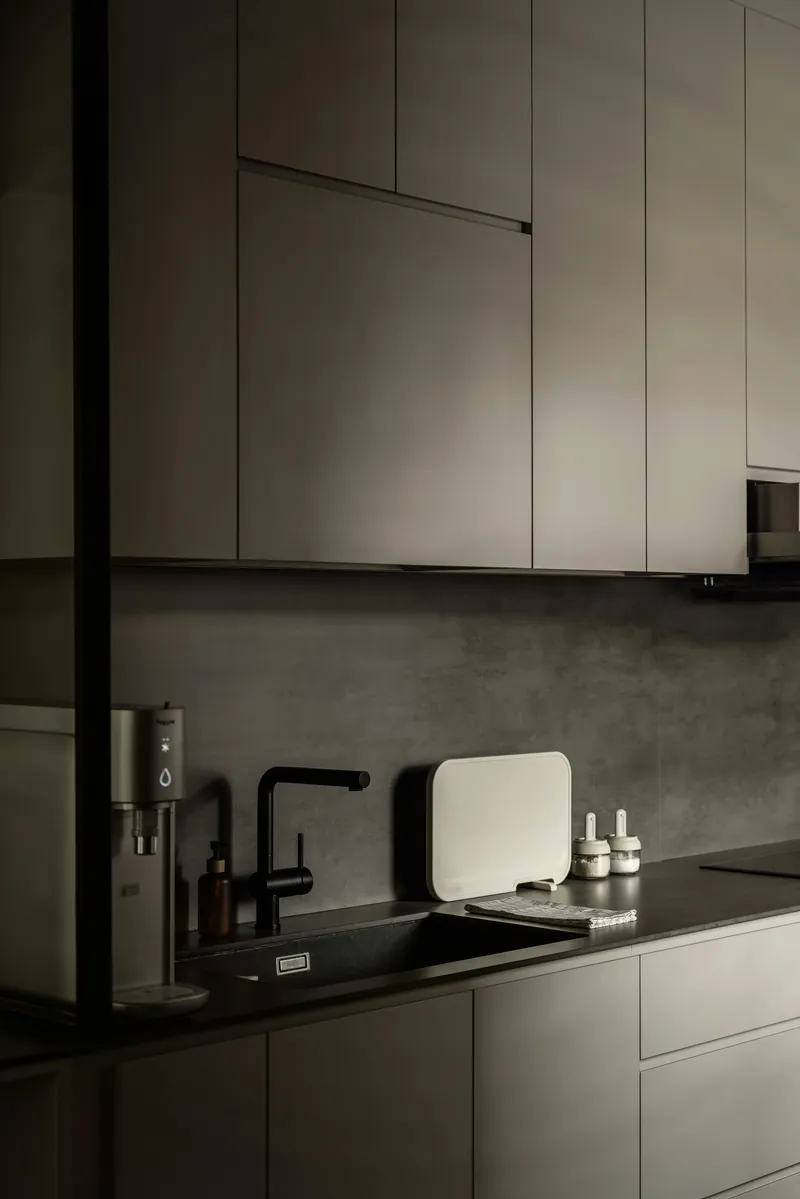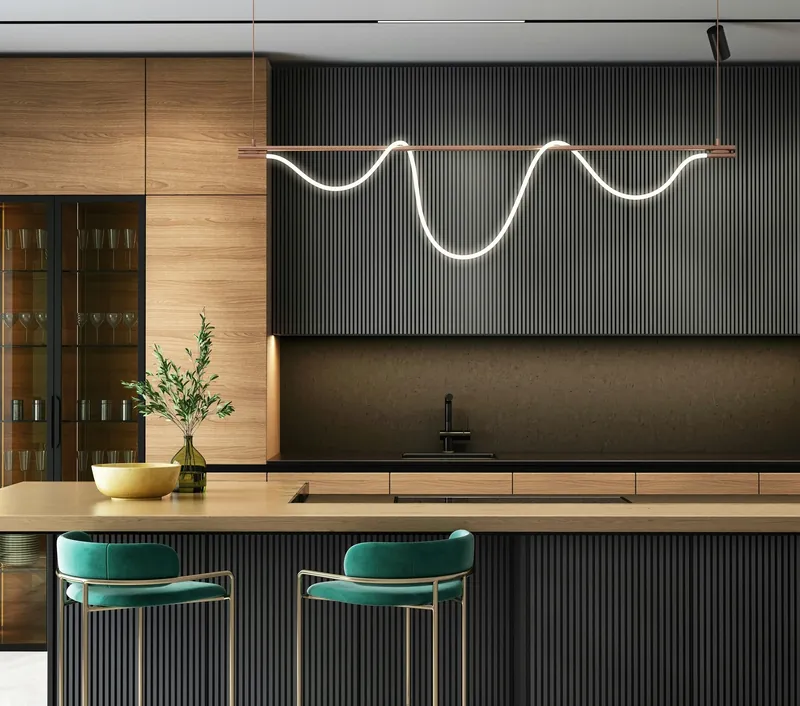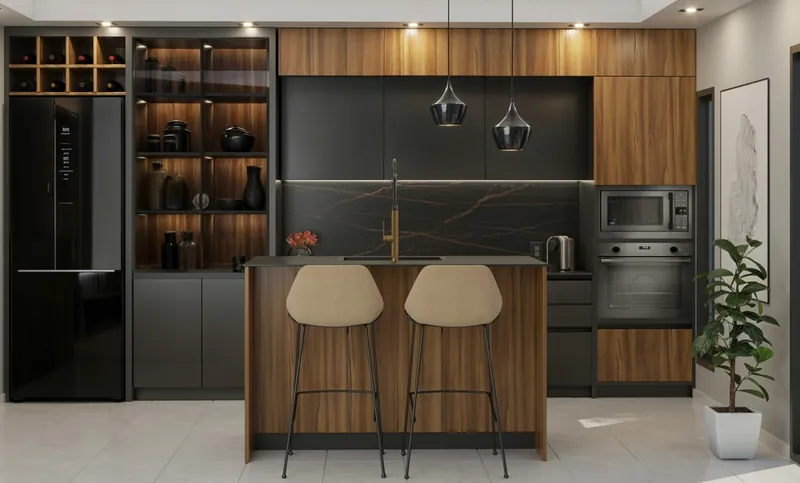
Modern kitchens hide everything. No handles, no visible hinges, no toe-kick shadow, no grout line if we can avoid it, appliances behind matching panels. The result reads calm and uncluttered — and it only reads that way if the tolerances are right.
The trade-off is unforgiving: a shaker door with a 3 mm inconsistency disappears into the frame detail. A slab door with the same error is the only thing you will look at.
What makes a kitchen modern rather than just new?
Four things: flat slab door fronts with no applied moulding, handleless opening mechanisms, integrated appliances behind matching panels, and continuous surfaces — a full-height stone splashback rather than tile, and a waterfall island end rather than a finished panel.
Everything else follows from those. Cabinetry runs floor to ceiling to remove the dust ledge. Lighting is recessed or hidden in a reveal rather than surface-mounted. Toe kicks are set back and sometimes lit so the run appears to float.
The finish palette is narrower than it looks. Most modern kitchens we build use two materials and one accent: a matte painted or laminated slab, a timber veneer, and black or brass hardware where hardware is visible at all.
Choosing a handleless system
There are three handleless systems and they behave differently. J-pull is the most practical and cheapest. Recessed rail gives the cleanest line and costs $600 to $1,800 more per kitchen. Push-to-open looks purest but adds mechanisms that eventually fail, and is a poor choice on drawers you open with full hands.
| System | How it opens | Added cost | Watch out for |
|---|---|---|---|
| J-pull / lip profile | Routed lip on the door edge | Included – $400 | Collects crumbs; needs wiping |
| Recessed aluminium rail | Continuous channel behind the door | $600 – $1,800 | Rail colour must match; visible from low angles |
| Push-to-open (mechanical) | Press to release, spring to open | $450 – $1,200 | Fingerprints on matte finishes; mechanisms wear |
| Push-to-open (electric) | Servo drive on drawers | $1,600 – $4,500 | Needs power in the cabinet; a repair item |
Our default recommendation for a family kitchen is J-pull on drawers and recessed rail on tall units: the practical option where hands are full, the clean line where it is seen.
Finishes that survive a real kitchen
Matte fingerprint-resistant laminates and painted MDF in a low-sheen catalysed lacquer are what we specify most. High-gloss acrylic looks spectacular in a showroom and shows every fingerprint and every micro-scratch in a north-facing Vancouver kitchen where the light rakes across it.
Timber veneer on slab doors needs a continuous grain match across the run to look deliberate rather than accidental. That is a cabinetry-shop decision made before cutting, not something that can be fixed later.
For the surface, see quartz countertops: a full-height quartz splashback in the same slab as the counter is the single detail that most makes a kitchen read as modern rather than merely current.
Lighting a minimal kitchen
Minimal kitchens have nowhere to hide a light fitting, so lighting has to be designed at rough-in rather than chosen at the end. Three layers do it: recessed downlights on a dimmer over the walkways, a continuous LED strip in a reveal under the wall cabinets for task light, and something sculptural over an island.
Colour temperature matters more than people expect in this city. In a kitchen that gets grey light for months, 2700K reads warm and comfortable; 4000K reads clinical. We specify 2700–3000K with a CRI above 90 so food actually looks like food. See kitchen lighting installation.