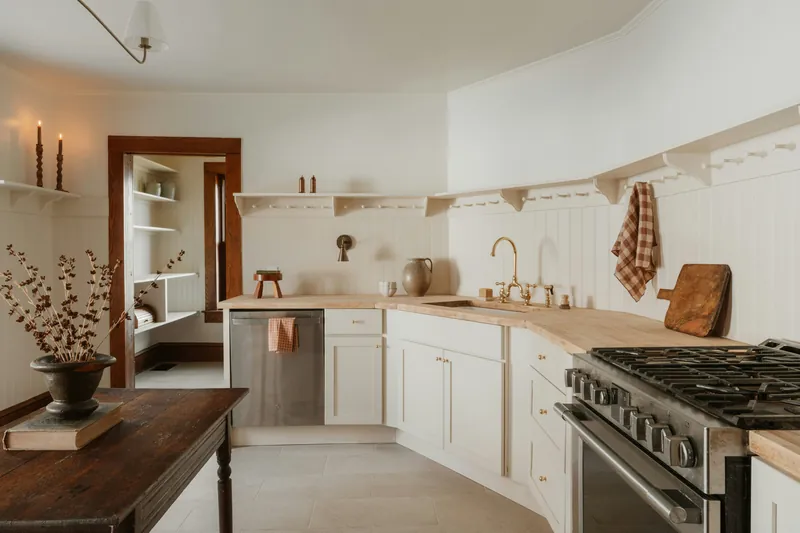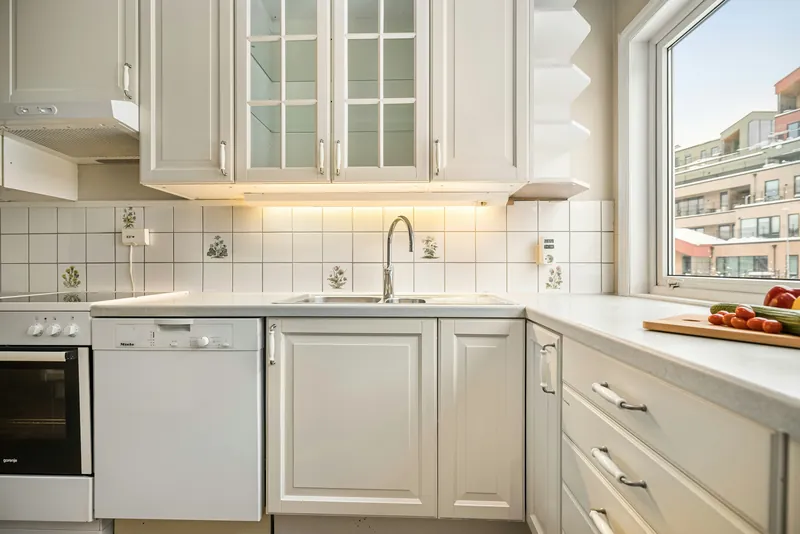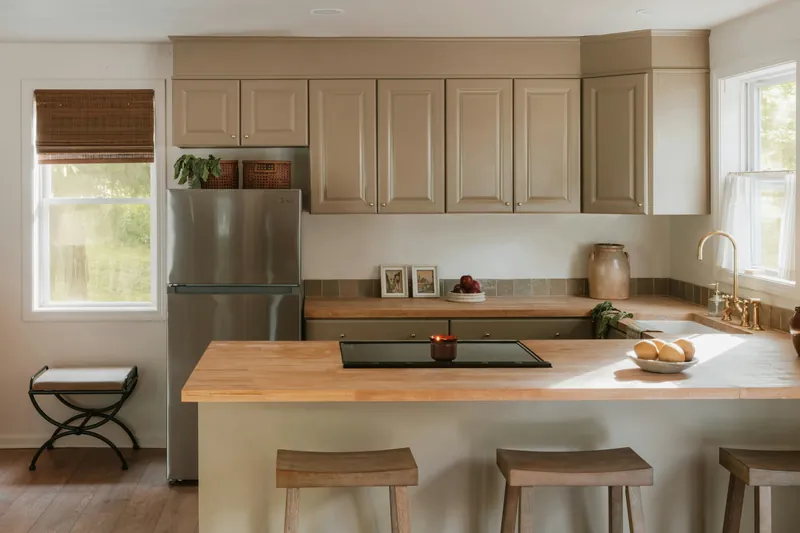
Refinishing keeps everything — boxes, doors, layout — and changes the colour. When the doors are solid wood or a well-made MDF and you simply do not like the finish, it is the highest-return money in a kitchen.
The entire outcome depends on process. Kitchen cabinets carry years of cooking grease, and paint over grease fails within months no matter how good the paint is. Degreasing, sanding and priming are 70% of the labour on a proper refinish and 0% of the labour on a cheap one.
Can you paint kitchen cabinets and have it actually last?
Yes, if they are degreased, sanded, primed with a bonding primer and sprayed with a catalysed or waterborne alkyd finish that cures hard. Done that way a refinish lasts 8 to 12 years. Brushed wall paint over unwashed doors starts chipping at the handles within a year.
Cure time is the part people do not expect. The finish is dry to touch in hours but continues hardening for two to three weeks. During that window doors should be closed gently and nothing should be left resting against a painted face, or it prints.
We rehang the doors with felt bumpers and tell you exactly what to avoid for the first fortnight, because the two most common early failures are both from handling an uncured finish.
How the process runs
Assessment
We check what the doors are actually made of. Thermofoil and some laminates cannot be refinished and we will say so.
At the measureRemoval and labelling
Every door and drawer front removed, numbered and mapped so it returns to the same opening.
half a dayDegrease and sand
Heavy degreasing, then sanding to a key. The step that decides whether the finish lasts.
1 dayPrime and spray
Doors sprayed off site in a booth; frames sprayed in place behind sealed containment with extraction.
2 daysCure and rehang
Doors returned, rehung, adjusted, new hardware fitted. Full cure continues for 2–3 weeks.
half a dayWhat can and cannot be refinished
| Door material | Refinishable? | Notes |
|---|---|---|
| Solid wood (maple, oak, birch) | Yes — ideal | Open-grain oak needs grain filling for a smooth finish |
| MDF, painted | Yes — ideal | Takes a sprayed finish better than solid wood |
| Veneered plywood | Yes | Provided the veneer is intact and not lifting |
| Thermofoil / vinyl wrap | No | The foil delaminates; these need refacing or replacement |
| High-pressure laminate | Rarely | Adhesion is poor and the result is unreliable |
| Melamine | No | Nothing bonds to it dependably |
If your doors cannot be refinished, refacing at $7,000 to $16,000 is the next step up and gives you a free choice of style.
Colour choices that hold up in a Vancouver kitchen
Off-whites, warm greys, deep greens and near-blacks are what we spray most. Pure brilliant white is the one to be careful with here: under grey west-coast daylight it reads cold and blue, which is why warm whites with a touch of yellow or grey in them are more forgiving in this city than they are elsewhere.
Sheen matters as much as colour. A satin or low-sheen finish hides surface imperfection and fingerprints; high gloss shows both. On a door that has been refinished rather than replaced, satin is almost always the right call.
The other decision worth making: painting the uppers and lowers differently. A lighter upper with a deeper base colour costs nothing extra, makes a small kitchen feel taller, and is much easier to live with long-term than an all-dark kitchen.
What refinishing does not fix
It does not fix a layout, add storage, or change a door style. Paint on a dated cathedral-arch oak door produces a painted cathedral-arch oak door.
It also does not fix hardware. If the hinges are worn and the doors sit unevenly, budget $300 to $800 to replace them at the same time — the doors are already off, so it is the cheapest it will ever be.
The combination that works hardest: refinished doors, new hardware, new countertops and under-cabinet lighting. $12,000 to $18,000 all in, and most people cannot tell it was not a full renovation.