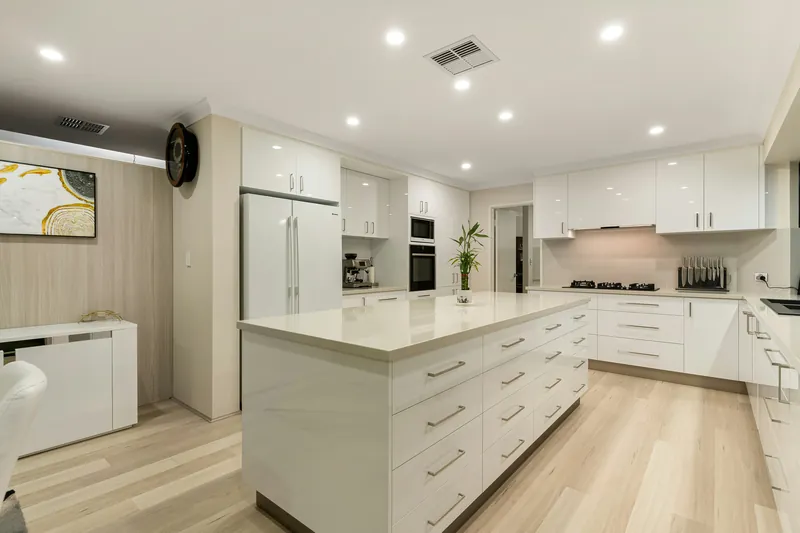
IKEA’s SEKTION system is well engineered: sturdy carcasses, excellent interior fittings, and hardware from the same manufacturers used in far more expensive kitchens. The weakness is not the product. It is that the system assumes a level wall and a competent install, and provides no forgiveness for either being absent.
We install IKEA kitchens across Metro Vancouver every month, both as full kitchens and as the carcass system behind third-party custom doors — which is one of the better value strategies available in this market.
What is different about installing an IKEA kitchen?
Three things: the boxes arrive flat and must be assembled on site, the cabinets hang from a horizontal suspension rail rather than being screwed through their backs individually, and the system relies on cover panels and fillers to finish exposed ends. Get the rail level and the rest follows.
The rail is the whole job. Every cabinet in the run hangs from it, so an error of 3 mm in the rail is 3 mm of error in every box, and it compounds visibly across a long wall. We set it with a laser rather than a spirit level.
The second common failure is filler strategy. IKEA boxes come in fixed widths, so in a Vancouver room that is not a whole number of modules wide, the leftover has to go somewhere. Planned properly it goes at the ends and disappears. Improvised at the wall, it ends up as a visible strip in the middle of a run.
What IKEA cabinetry is and is not good at
| Where IKEA is strong | Where it is weak | |
|---|---|---|
| Carcasses | Sturdy, well-engineered, good value | Particleboard core — the sink base is vulnerable |
| Hardware | Blum runners and hinges; excellent | None |
| Interior fittings | Best in class at any price | None |
| Door finishes | Wide range, replaceable later | Foil-wrapped doors can delaminate near heat |
| Sizing | Consistent, modular, easy to plan | Fixed widths — filler panels in an out-of-square room |
| Warranty | 25 years on most kitchen ranges | Covers the product, not the installation |
The strategy we recommend most: IKEA carcasses and interior fittings with custom doors from a third-party supplier. Roughly $16,000 to $26,000 for a kitchen that looks like a $35,000 one.
How much does IKEA kitchen installation cost?
Professional installation of an IKEA kitchen in Vancouver costs $3,000 to $7,000 in labour for a typical 12 to 15 cabinet kitchen, including on-site assembly. The cabinetry itself is usually $4,000 to $9,000, so a complete IKEA kitchen installed runs roughly $8,000 to $16,000 before countertops.
Add countertops at $3,800 to $9,500 for quartz, and a backsplash at $1,800 to $4,200. A full IKEA kitchen with quartz counters and tile typically lands between $16,000 and $28,000 installed.
That makes it the best value route to a completely new kitchen, provided the room is reasonably square and you are happy within the module sizes.
Planning an IKEA kitchen before you order
We can review your IKEA plan before you order. Half an hour on a plan has saved clients several trips to Coquitlam and, more than once, an entire wall’s worth of wrongly sized cabinets.
- Measure the room yourself and then have it measured properly — the planner is only as good as its input
- Decide the filler strategy before ordering: where the leftover width goes decides how the kitchen looks
- Order cover panels for every exposed end, including the side of a dishwasher run
- Check appliance dimensions against the module sizes; a 36-inch range does not fit a 30-inch opening
- Order the toe kick in the right length and colour — it is the item most often short
- Check every carton against the order on delivery, before installation day
What we do that a handyman install does not
Laser-set the rail rather than using a spirit level. Assemble boxes square and check them for racking before hanging. Scribe cover panels to the wall rather than relying on the caulk line. Cut fillers to the actual wall profile. And spend the final half day adjusting every door and drawer to a consistent reveal.
That last step is what makes an IKEA kitchen stop looking like an IKEA kitchen. The hardware has three-axis adjustment for exactly this reason, and almost nobody uses it fully.