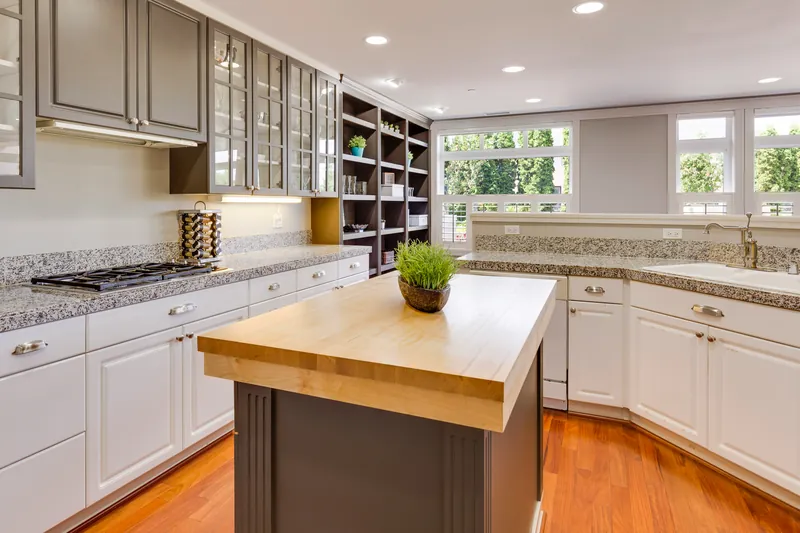
North Vancouver’s post-war housing produced a lot of cabinetry that is genuinely worth keeping. The 1970s and 80s kitchens in Lynn Valley, Edgemont and Upper Lonsdale were frequently built with plywood carcasses and solid wood doors — better construction than much of what is sold new at the same price today.
The complication is the climate. The North Shore gets substantially more rain than the city and ambient humidity swings wide, and forty years of that finds any weakness in a sink base or a cabinet against an exterior wall.
Assessing North Shore cabinet boxes properly
A visual check is not enough here. We look at the sink base floor and back panel, the cabinet against any exterior wall, and the toe kick — the three places sustained humidity shows first. Swelling, delamination or a musty smell means the boxes will not take refacing.
Where the carcasses are plywood and dry, they are frequently better than new budget cabinetry and refacing is straightforwardly the right answer. Where they are particleboard and the sink base has taken water, new doors on them is money spent on a structure that is already going.
One North Shore-specific check: cabinets on an exterior wall in a house with poor insulation can have taken years of condensation on their back panel. That is not visible without emptying the cabinet, which is why we ask to look inside rather than judging from the front.
Why 1970s and 80s North Shore cabinetry refaces well
Cabinetry from this era was often built with plywood carcasses, solid wood face frames and generous material thicknesses. The construction is sound; what dates it is the door style, the finish and the hardware — precisely the three things refacing replaces.
The typical candidate: honey-stained oak raised-panel doors, brass knobs, self-closing surface hinges that no longer close squarely, and a cathedral arch on the upper doors that places the kitchen firmly in 1982.
New painted or veneered slab or shaker doors, matching laminate on the frames, modern soft-close concealed hinges and new hardware transform it entirely — on a carcass that will outlast most new kitchens.
A representative North Vancouver refacing project
The pattern: a 1979 split-level in Lynn Valley, 16 cabinets, plywood carcasses in good condition, oak raised-panel doors, brass hardware, and worn surface hinges so half the doors sit proud.
What gets done: new painted MDF shaker doors and drawer fronts in a warm off-white, matching rigid laminate on the face frames and end panels, all new soft-close concealed hinges, new full-extension soft-close runners in the two drawer banks that were worn, brushed brass bar handles, and the final adjustment pass.
Typical cost $11,000 to $15,000 for 16 cabinets. Six days on site, after a three-week door lead. Many clients add new quartz counters at the same time, which brings the total to $16,000 to $23,000 — against $55,000 or more for the equivalent full renovation.
Refacing versus replacing on the North Shore
| Refacing | Full replacement | |
|---|---|---|
| Cost, 16-cabinet kitchen | $11,000 – $16,000 | $40,000 – $70,000 |
| Time on site | 5 – 7 days | 5 – 7 weeks |
| Kitchen usable during work | Mostly | No |
| Panel upgrade triggered? | No — no electrical work | Often — one in three homes here |
| Layout changes possible | No | Yes |
| Suits sound plywood boxes | Ideal | Wasteful |
| Suits water-damaged boxes | No | Necessary |
The panel line matters here. A refacing job triggers no electrical work, which means it avoids the $2,500 to $6,000 upgrade that a full renovation frequently surfaces in this housing stock.